 |
|
|
|
|
|
Politics
> Is This Part of the Problem?
|
|
New Topic |
Post Reply
|
<< |
1 |
>>
| 1. Saturday, September 2, 2006 3:52 PM |
| nuart |
Is This Part of the Problem? |
Member Since
12/18/2005
Posts:7632
View Profile
Send PM
|
If, according to the UN, only 10,000 books have been translated into Arabic (one of them being the perennial bestseller, "Mein Kampf") over the past millenium, could this explain anything? The following article describes it as "intellectual isolation" in the Arab world. I'd really be interested to know if any of you think this is a big deal or not. Susan Atlantic Unbound | March 7, 2006
Social Studies | by Jonathan Rauch
In Arabic, 'Internet' Means 'Freedom'

A Baghdad scholar is secretly working to expose Arabs to Western books on democracy and liberalism via the Internet. .....  dd though it may sound, somewhere in Baghdad a man is working in secrecy to edit new Arabic versions of Liberalism, by the Austrian economist Ludwig von Mises, and In Defense of Global Capitalism, by the Swedish economist Johan Norberg. He is doing this at some risk of kidnap, beating, and death, because he hopes that a new Arabic-language Web site, called LampofLiberty.org—MisbahAlHurriyya.org in Arabic—can change the world by publishing liberal classics. dd though it may sound, somewhere in Baghdad a man is working in secrecy to edit new Arabic versions of Liberalism, by the Austrian economist Ludwig von Mises, and In Defense of Global Capitalism, by the Swedish economist Johan Norberg. He is doing this at some risk of kidnap, beating, and death, because he hopes that a new Arabic-language Web site, called LampofLiberty.org—MisbahAlHurriyya.org in Arabic—can change the world by publishing liberal classics. Odder still, he may be right. Interviewed by e-mail, he asks to be known by a pseudonym, H. Ali Kamil. A Shiite from Iraq's south, he is an accomplished scholar, but he asks that no other personal details be revealed. Two of his friends have been killed in the postwar insurgency and chaos, one shot and the other "slaughtered." Others of his acquaintance are in hiding, visiting their families in secret. He has been threatened for working with an international agency. Now he is collaborating not with foreign agencies but with foreign ideas. He has made Arabic translations of all or parts of more than two dozen articles and nine books and booklets. "None," he says, "were previously translated, to my knowledge, for the simple reason that they are all on liberalism and democracy, which unfortunately have little audience and advocators in the Middle East, where almost all publishing houses and press outlets are governmental—i.e., anti-liberal." Kamil's work is anonymous out of fear, not modesty. Translating Frederic Bastiat's The Law, he says, took 20 days of intense labor. "I am proud of that, especially when I knew that the book has never been translated before. This is one of the works my heart is aching for not having my name in its front page." Asked how he began this work, he recounts meeting an American who was lecturing in Baghdad on principles of constitutional government. The message struck home. "Yes, you could say I am libertarian," Kamil says. "I believe in liberty for all, equality and human rights, freedom and democracy, free-market ethics, and I hate extremism in everything. I believe in life more than death as being the way to happiness."  he American was Tom G. Palmer, a senior fellow at the Cato Institute in Washington and a man who cares a lot about books. (So much so, that he always walks around with a satchel full of them.) When the Soviet Union fell, he worked on making key liberal texts available in Russian and the languages of the former Soviet Bloc. How can democracy and markets thrive, after all, without the owner's manual? he American was Tom G. Palmer, a senior fellow at the Cato Institute in Washington and a man who cares a lot about books. (So much so, that he always walks around with a satchel full of them.) When the Soviet Union fell, he worked on making key liberal texts available in Russian and the languages of the former Soviet Bloc. How can democracy and markets thrive, after all, without the owner's manual? In 2004, Palmer traveled to Iraq for an education-ministry conference on reforming the schools. Having expunged compulsory Baathist education, the Iraqis were figuring out what came next. "They desperately wanted something different from what they had," Palmer says. Like many Albanians and Romanians he met after the Soviet Union collapsed, Iraqis pulled him aside to tell stories of family members harassed or killed by the fallen regime. The strikingly ubiquitous statues and images of Saddam Hussein testified to how thoroughly the Baathist dictatorship had dominated intellectual life. Intellectual isolation is a widespread Arab phenomenon, not just an Iraqi one. Some of the statistics are startling. According to the United Nations' 2003 "Arab Human Development Report," five times more books are translated annually into Greek, a language spoken by just 11 million people, than into Arabic. "No more than 10,000 books were translated into Arabic over the entire past millennium," says the U.N., "equivalent to the number translated into Spanish each year." Authors and publishers must cope with the whims of 22 Arab censors. "As a result," writes a contributor to the report, "books do not move easily through their natural markets." Newspapers are a fifth as common as in the non-Arab developed world; computers, a fourth as common. "Most media institutions in Arab countries remain state-owned," the report says. No wonder the Arab world and Western-style modernity have collided with a shock. They are virtually strangers, 300 years after the Enlightenment and 200 years after the Industrial Revolution. Much as other regions may be cursed with disease or scarcity, in recent decades the Arab world has been singularly cursed with bad ideas. First came Marxism and its offshoots; then the fascistic nationalism of Nasserism and Baathism; now, radical Islamism. Diverse as those ideologies are, they have in common authoritarianism and the suppression of any true private sphere. Instead of withering as they have done in open competition with liberalism, they flourished in the Arab world's relative isolation. Palmer's first thought was to launch a think tank in Iraq, but that fizzled when the institute's prospective president bailed out at his wife's urging, for fear of his life. Last April, Palmer returned to Iraq to give talks on constitutional and free-market principles. At one such talk he met Kamil. Returning to Washington, Palmer connected with other liberal Arabs and, with their help, began commissioning translations: of Bastiat, Mises, Adam Smith, John Stuart Mill, Voltaire, David Hume, F.A. Hayek, and such influential contemporary writers as Mario Vargas Llosa and Hernando de Soto. Most of this stuff has either been unavailable in Arabic or available spottily, intermittently, and in poor translations.  n January, MisbahAlHurriyya.org made its Internet debut. Today it hosts about 40 texts; Palmer aims for more like 400, including a shelf of books. (It currently offers an abridged edition of Hayek's Road to Serfdom and Bastiat's The Law. The Norberg book is coming soon.) Sponsored by the Cato Institute, it joins a small but growing assortment of Arabic-language blogs and Web sites promulgating liberal ideas. n January, MisbahAlHurriyya.org made its Internet debut. Today it hosts about 40 texts; Palmer aims for more like 400, including a shelf of books. (It currently offers an abridged edition of Hayek's Road to Serfdom and Bastiat's The Law. The Norberg book is coming soon.) Sponsored by the Cato Institute, it joins a small but growing assortment of Arabic-language blogs and Web sites promulgating liberal ideas. "The Internet is a historical opportunity for Arab liberalism," Pierre Akel, the Lebanese host of one such site, metransparent.com, said in a recent interview with Reason magazine. "In the Arab world, much more than in the West, we can genuinely talk of a blog revolution." The Internet provides Arab liberals with the platform and anonymity that they need; helpfully, Arabic-language blogware, developed by liberal bloggers, recently came online for free downloading. During the recent controversy over a Danish newspaper's publication of cartoons depicting the Prophet Mohammed, an Egyptian blog, EgyptianSandMonkey.blogspot.com, made a splash by pointing out that no one had protested when the same cartoons had previously been published on the front page of an Egyptian newspaper—and by calling, sardonically, for a Muslim boycott of Egypt. (The site boasts a "Buy Danish" sticker.) Since the 1950s, the U.S. State Department (and the former U.S. Information Agency, now folded into State) has steadily commissioned and published Arabic translations of American books, including a sprinkling of political classics, such as The Federalist Papers. Its translation programs are run by the embassies in Cairo and Jordan. According to Alberto Fernandez, of the State Department's Near Eastern Affairs Bureau, a third program, managed from Washington and still fledgling, seeks to bring translated books to Iraq. Those print editions, worthy though they are, are subject to the vagaries of commercial book distribution, which is decidedly spotty in the region. The U.N. report notes that in the Arab world—a region of 284 million—a book that sells 5,000 copies qualifies as a best-seller. The Internet, in contrast, makes possible worldwide, instant distribution, at a nearly negligible cost. MisbahAlHurriyya.org relies heavily on volunteers and donated Web services; its budget, says Palmer, is in the five figures. Thanks to e-mail, conferring and passing manuscripts between Washington, Baghdad, and Amman—a logistical nightmare in the days of mail and fax—is a cinch. The site, entirely in Arabic, advertises on the popular Arabic Web sites Albawaba.com and Aljazeera.net. The whole enterprise was impossible a decade ago. Firmly establishing liberal ideas took centuries in the West, and may yet take decades in the Arab world. Authoritarian and sectarian and tribalist notions are easier to explain than liberal ones, and it is inherently harder to build trust in mercurial markets and flowing democratic coalitions than in charismatic leaders, visionary clerics, and esteemed elders. The liberal world's intellectual underpinnings are as difficult to grasp as its cultural reach is difficult to escape. Thus the disjunction within which Baathism, Islamism, and Arab tribalism have festered. Yet few who are genuinely intellectually curious can read J.S. Mill or Adam Smith and come away entirely unchanged. The suffocating Arab duopoly of state-controlled media and Islamist pulpits is cracking—only a little bit so far, but keep watching. In the Arab world, the Enlightenment is going online.
“Half a truth is often a great lie.” Ben Franklin
|
| 2. Saturday, September 2, 2006 12:39 PM |
| herofix |
RE: Is This Part of the Problem? -OOPS - HELP -Should go to POLITICS!!! |
Member Since
12/18/2005
Posts:2500
View Profile
Send PM
|
Thanks for catching up to what I've said on here a billion times! Yes, this is a massive part of the problem. Hopefully someone inspired by this will decide to translate some more books. A recipe for success: Sport, Sex, Music, Cinema, Alcohol. Flood the ME with these things and our job is done. It is a rare person who can be exposed to these pleasures and end up an extremist. The Internet should make this easier than it would have been a few years ago. 'There's more to life than books, you know, but not much more' - S.P. Morrissey
An Inverted Pyramid of Piffle
|
| 3. Saturday, September 2, 2006 1:14 PM |
| nuart |
RE: Is This Part of the Problem? -OOPS - HELP -Should go to POLITICS!!! |
Member Since
12/18/2005
Posts:7632
View Profile
Send PM
|
A billion times and I've not caught it once? Okay, if you're that concerned and you are on a university campus, guess what? You're nominated to learn Arabic and get started translating, Andrew! Susan
“Half a truth is often a great lie.” Ben Franklin
|
| 4. Saturday, September 2, 2006 1:50 PM |
| B |
RE: Is This Part of the Problem? -OOPS - HELP -Should go to POLITICS!!! |
Member Since
12/18/2005
Posts:1263
View Profile
Send PM
|
Using this logic, though, one would think the 19 terrorists from September 11th would have a change of heart after living in the US for awhile.
-B
|
| 5. Sunday, September 3, 2006 1:04 AM |
| Raymond |
RE: Is This Part of the Problem? -OOPS - HELP -Should go to POLITICS!!! |
Member Since
12/18/2005
Posts:1664
View Profile
Send PM
|
Hero said "A recipe for success: Sport, Sex, Music, Cinema, Alcohol. Flood the ME with these things and our job is done. It is a rare person who can be exposed to these pleasures and end up an extremist." Right, those guys were drinking and going to strip clubs. And why the problem then with homegrowns ? Still, I like the idea of exposing the ME with our culture. Ha, it will either turn them around or push them over the edge in disgust with our decadence. Edit : to properly present this post I added friend Hero's quote to which I was referring, not serious books.
|
| 6. Saturday, September 2, 2006 2:30 PM |
| Jazz |
RE: Is This Part of the Problem? -OOPS - HELP -Should go to POLITICS!!! |
Member Since
12/19/2005
Posts:2214
View Profile
Send PM
|
hmm .. writing Dutch is sooo 2001 .. English is today's Dutch you know .. "overdrijvenisookeenvak"

|
| 7. Saturday, September 2, 2006 3:35 PM |
| herofix |
RE: Is This Part of the Problem? -OOPS - HELP -Should go to POLITICS!!! |
Member Since
12/18/2005
Posts:2500
View Profile
Send PM
|
Well, I've said it at least twice in the past three years. Here I thought the whole world was hanging on every word I say...
An Inverted Pyramid of Piffle
|
| 8. Saturday, September 2, 2006 3:39 PM |
| herofix |
RE: Is This Part of the Problem? -OOPS - HELP -Should go to POLITICS!!! |
Member Since
12/18/2005
Posts:2500
View Profile
Send PM
|
| QUOTE:Right, those guys were drinking and going to strip clubs. And why the problem then with homegrowns ? Still, I like the idea of exposing the ME with our culture. Ha, it will either turn them around or push them over the edge in disgust with our decadence. |
Hmm....maybe they should have just went to strip clubs and drank sometimes, and then read some books some other times.
As far as the homegrown thing, I bet those people never read books, aside from what they are given by their imams.
An Inverted Pyramid of Piffle
|
| 9. Saturday, September 2, 2006 3:58 PM |
| nuart |
RE: Is This Part of the Problem? |
Member Since
12/18/2005
Posts:7632
View Profile
Send PM
|
Right you are, Andrew, when it comes to only reading books given by a controlling imam. When non-Arabic Muslim children are raised in those madrassas or sent from European homes to study in these type establishments, they are forced to memorize the Koran though often they don't speak Arabic. So, instead of actually reading a book -- i.e. the Koran -- they are parroting by rote words which have little meaning or context. Anyway, I'm glad this thread is where it should be and I'm glad we seem to be in agreement with this development. Nothing will be fast but I think this shows great promise even if it takes a decade for some would-be leader to emerge after having read the Western Civ canon on the Internet. Susan
“Half a truth is often a great lie.” Ben Franklin
|
| 10. Sunday, September 3, 2006 6:03 AM |
| jordan |
RE: Is This Part of the Problem? |
Admin
Member Since
12/17/2005
Posts:2274
View Profile
Send PM
|
I had the same thought as Ray's when reading Andrew's post about pushing more western civilization "morality" to the ME. This is what I keep trying to to tell everyone for the past few years - at least a million times! Everyone always tried to explain the reason for "hating the US" is because of US foreign policies, and I disagree with that (and always told people to go and read Bin Laden's letters - one of them talks about Clinton's little discretion in the Oral Office). Yes, foreign policy may be part of it, but even if our foreign policies weren't hated, extremists would hate our (to use Bush's words) "way of life." Western morality is 100% in opposition to Muslim extremists. Now don't get me wrong - pushing ideas and principles of freedom and liberty is a good thing. I think that will ultimately help, and I'm thrilled this guy is doing such a thing! We need more like him! Ultimately enough people learn these things and they will drown out and deal with their own extremists.
Jordan .
|
| 11. Sunday, September 3, 2006 11:24 AM |
| herofix |
RE: Is This Part of the Problem? |
Member Since
12/18/2005
Posts:2500
View Profile
Send PM
|
| QUOTE: Ultimately enough people learn these things and they will drown out and deal with their own extremists. |
Right, that's what I mean. Make love, not war, man.
An Inverted Pyramid of Piffle
|
| 12. Tuesday, September 5, 2006 10:57 AM |
| nuart |
RE: Is This Part of the Problem? |
Member Since
12/18/2005
Posts:7632
View Profile
Send PM
|
Here's another part of the problem... too many US and Israeli flags to know what to do with in Pakistan! 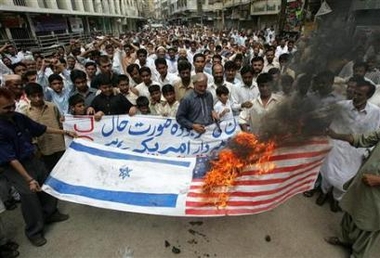
From our pals at Reuters along with this caption: Pakistani Shi'ite Muslims burn Israeli and U.S. flags during a protest against Israel's air strikes on Lebanon, in Karachi August 11, 2006. In the five years since the September 11 attacks, U.S. intervention abroad has fed the extremism it seeks to destroy and cemented the rise of political Islam as the ideology of choice for millions in the Middle East, experts say. (Athar Hussain/Reuters)
Ah, Athar Hussain, what a way to synthesize. Susan
“Half a truth is often a great lie.” Ben Franklin
|
| 13. Tuesday, September 5, 2006 2:27 PM |
| herofix |
RE: Is This Part of the Problem? |
Member Since
12/18/2005
Posts:2500
View Profile
Send PM
|
Can't really disagree with that synopsis, personally. It seems a bit opinionated for a caption, though. Maybe it is becoming so obvious it is just understood as the objective view. Jordan - the point is that it seems to be on the rise because of foreign policy. I don't think the Lewinsky affair would have been enough to push people over the edge into suicide missions. Just another little stick for that pompous and self-important bin Laden to beat us with so he can feel like a righteous warrior. On its own, I don't think that Clinton's indescretion would have tempted young British Muslims to blow themselves up on the tube. War in Iraq? Seems to have done, yeah.
An Inverted Pyramid of Piffle
|
| 14. Tuesday, September 5, 2006 3:03 PM |
| jordan |
RE: Is This Part of the Problem? |
Admin
Member Since
12/17/2005
Posts:2274
View Profile
Send PM
|
Again Andrew - I submit to you that extremists don't need the Iraq War, Afghanistan or anything else foreign policy wise to "get angry" at the US about. If that's the case, then explain to me the 90s terrorist acts against the US while beloved Bill Clinton was in office and we weren't being "mean" foreign policy wise, and yet....? Teh simple fact that the US supports Israel is enough to cause problems. Let's say for a moment, we didn't support Israel, then what? Would we suddenly be able to live with extremist Muslisms not threatening us? I don't believe so because I don't think this "jihad" is about foreign policies. I think that is an excuse for something bigger. I'll give to you the notion that Iraq War has made things worse. And just like 9/11 saw an incrase in military sign-ups, so would the Iraq War make Muslims want to "sign-up" too. The Iraq War becomes a poster child for everything bad regarding the US .
But without the Iraq War, we'd be dealing with the same issue - just one less reason to blow themselves up. Then it would be about Afghanistan (even though only a few on the far left view that war as "wrong"). And if it wasn't Afghanistan, it would be Israel. And if it wasn't Israel, it would be oil. And if it wasn't oil, it would be exporting immorality into the ME via Hollywood. And if it wasn't exporting immorality, it would be refusing to accept Allah as the one true God (ie the reporters recently). And if it wasnt' for that, then it would be tribal differences becase we'd all be Muslims then. ANY reason can be THE reason.
I've always stated that this issue is not about foreign policy exclusively. And that simply changing foreign policy won't "fix" the problem. This is about an extremist take on a religion. It's that simple. Foreign policy is only secondary.
Jordan .
|
| 15. Tuesday, September 5, 2006 4:53 PM |
| nuart |
RE: Is This Part of the Problem? |
Member Since
12/18/2005
Posts:7632
View Profile
Send PM
|
In the five years since the September 11 attacks, U.S. intervention abroad has fed the extremism it seeks to destroy and cemented the rise of political Islam as the ideology of choice for millions in the Middle East, experts say.
Like those BBC graphs, there may be some truth to the fact that in those five years having US troops on "sacred no infidels allowed" soil, may have riled the delicate sensibilities of nothing to lose extremists in the making. But it doesn't address the basic fact that these particular rather thin-skinned Pakistanis burning flags, who were not subjected to infidels on their shores, are easily driven to "extremism" and that in itself is a problem if you ask me. You did ask me, didn't you??? Jordan is correct when he points out the many prior acts of terrorism leading up to 9/11. Susan
“Half a truth is often a great lie.” Ben Franklin
|
| 16. Tuesday, September 5, 2006 6:11 PM |
| Raymond |
RE: Is This Part of the Problem? |
Member Since
12/18/2005
Posts:1664
View Profile
Send PM
|
This war with Islamists has been ebbing and flowing for about 1400 years. Islamists don't like Christians, Hindis, Buddists, Jews or Secularists. right ? Is this a 21st century phenonenon? No. Was there oil behind the Moors expansion into Europe? Was the Ottoman Empire established over oil ? And more recently, those guys would have brought down the Twin towers in 1993 if they could of-- pre Iraq war. The comforting part of the cause of the problem being foreign policy driven is that it is the West's fault and the West has the power to change things so that the jihadists will go away and leave us alone. That approach leaves things in our hands. We (would) have the control. I don't think it is that simple. A cartoon in a newspaper is enough to rile up those folks to burn, murder, and call for the death of the West.
|
|
New Topic |
Post Reply
|
Page 1 of 1 ::
<< |
1 |
>>
|
|
Politics
> Is This Part of the Problem?
|
| Users viewing this Topic (0) |
| |
Powered by JorkelBB 2006 (Version 1.0b)
|
|
|


