 |
|
|
|
|
<< |
1 |
>>
| 1. Tuesday, October 10, 2006 9:42 AM |
| nuart |
North Korea Nukes |
Member Since
12/18/2005
Posts:7632
View Profile
Send PM
|
Red Alert: North Korea -- Is There a Military Solution?Stratfor: October 9, 2006 SummaryWhatever the political realities may seem to dictate after a North Korean nuclear test, an overt military strike -- even one limited to cruise missiles -- is not in the cards. The consequences of even the most restrained attack could be devastating. AnalysisThe reported detonation of a nuclear device by North Korea on Oct. 9 raises the question of potential military action against North Korea. The rationale for such a strike would be simple. North Korea, given its rhetoric, cannot be allowed to have nuclear weapons. Therefore, an attack to deny them the facilities with which to convert their device into a weapon and deploy it is essential. If such an attack were to take place, it is assumed, the United States would play the dominant or even sole role. This scenario assumes that North Korea is as aggressive as its rhetoric. But what about North Korea's well-armed neighbors -- Russia, China, South Korea, Japan? Would they not be willing to assume the major burden of an attack against North Korea? Is the United States really willing to go it alone, even while engaged in combat in Iraq and Afghanistan? Leaving these obvious political questions aside for the moment, let's reverse the issue by posing it in military terms: What would a U.S. strike against North Korea look like? The USS Kitty Hawk is currently sitting in port at Yokosuka Naval Base, Japan. The USS Enterprise is operating in the Arabian Sea, while the Nimitz and the Stennis are conducting exercises off the coast of California. All are an ocean away, and none is less than a week's transit from the region. Nevertheless, naval cruise missiles are readily available, as are long-range strikes by B-2A Spirit stealth bombers and B-52H Stratofortresses and B-1B Lancers currently supporting NATO operations in Afghanistan out of Diego Garcia. A more robust strike package would take longer to deploy. When U.S. military planners have nightmares, they have nightmares about war with North Korea. Even the idea of limited strikes against the isolated nation is fraught with potential escalations. The problem is the mission. A limited attack against nuclear facilities might destabilize North Korea or lead North Korea to the conclusion that the United States would intend regime change. Regime preservation is the entire point of its nuclear capability. Therefore, it is quite conceivable that Kim Jong-Il and his advisors -- or other factions --might construe even the most limited military strikes against targets directly related to missile development or a nuclear program as an act threatening the regime, and therefore one that necessitates a fierce response. Regime survival could very easily entail a full, unlimited reprisal by the Korean People's Army (KPA) to any military strike whatsoever on North Korean soil. North Korea has some 10,000 fortified artillery pieces trained on Seoul. It is essential to understand that South Korea's capital city, a major population center and the industrial heartland of South Korea, is within range of conventional artillery. The United States has been moving its forces out of range of these guns, but the South Koreans cannot move their capital. Add to this the fact that North Korea has more than 100 No-Dong missiles that can reach deep into South Korea, as well as to Japan, and we can see that the possibility for retaliation is very real. Although the No-Dong has not always been the most reliable weapon, just the possibility of dozens of strikes against U.S. forces in Korea and other cities in Korea and Japan presents a daunting scenario. North Korea has cultivated a reputation for unpredictability. Although it has been fairly conservative in its actions compared to its rhetoric, the fact is that no one can predict North Korea's response to strikes against its nuclear facilities. And with Seoul at risk -- a city of 20 million people -- the ability to take risks is limited. The United States must assume, for the sake of planning, that U.S. airstrikes would be followed by massed artillery fire on Seoul. Now, massed artillery is itself not immune to countermeasures. But North Korea's artillery lies deep inside caves and fortifications all along the western section of the demilitarized zone (DMZ). An air campaign against these guns would take a long time, during which enormous damage would be done to Seoul and the South Korean economy -- perhaps on the order of several hundred thousand high-explosive rounds per hour. Even using tactical nuclear weapons against this artillery would pose serious threats to Seoul. The radiation from even low-yield weapons could force the evacuation of the city. The option of moving north into the North Korean defensive belt is an option, but an enormously costly one. North Korea has a huge army and, on the defensive, it can be formidable. Fifty years of concerted military fortification would make Hezbollah's preparations in southern Lebanon look like child's play. Moving U.S. and South Korean armor into this defensive belt could break it, but only with substantial casualties and without the certainty of success. A massive stalemate along the DMZ, if it developed, would work in favor of the larger, defensive force. Moreover, the North Koreans would have the option of moving south. Now, in U.S. thinking, this is the ideal scenario. The North Korean force on the move, outside of its fortifications, would be vulnerable to U.S. and South Korean airstrikes and superior ground maneuver and fire capabilities. In most war games, the defeat of North Korea requires the KPA to move south, exposing itself to counterstrikes. However, the same war-gaming has also supposed at least 30 days for the activation and mobilization of U.S. forces for a counterattack. U.S. and South Korean forces would maintain an elastic defense against the North; as in the first war, forces would be rushed into the region, stabilizing the front, and then a counterattack would develop, breaking the North Korean army and allowing a move north. There are three problems with this strategy. The first is that the elastic strategy would inevitably lead to the fall of Seoul and, if the 1950 model were a guide, a much deeper withdrawal along the Korean Peninsula. Second, the ability of the U.S. Army to deploy substantial forces to Korea within a 30-day window is highly dubious. Desert Storm and Iraqi Freedom both required much longer periods of time. Finally, the U.S. Army is already fighting two major ground wars and is stretched to the breaking point. The rotation schedule is now so tight that units are already spending more time in Iraq than they are home between rotations. The idea that the U.S. Army has a multidivisional force available for deployment in South Korea would require a national mobilization not seen since the last Korean War. It comes down to this: If the United States strikes at North Korea's nuclear capabilities, it does so placing a bet. And that bet is that North Korea will not respond. That might be true, but if it is not true, it poses a battlefield problem to which neither South Korea nor the United States will be able to respond. In one scenario, the North Koreans bombard Seoul and the United States makes a doomed attempt at shutting down the massive artillery barrage. By the time the guns are silenced -- even in the best-case scenarios -- Seoul will be a mess. In another scenario, the North Korean army executes an offensive of even minimal competence, which costs South Korea its capital and industrial heartland. The third is a guerrilla onslaught from the elite of the North Korean Army, deployed by mini-subs and tunnels under the DMZ. The guerrillas pour into the south and wreak havoc on U.S. military installations. That is how a U.S. strike -- and its outcome -- might look. Now, what about the Chinese and Russians? They are, of course, not likely to support such a U.S. attack (and could even supply North Korea in an extended war). Add in the fact that South Korea would not be willing to risk destroying Seoul and you arrive at a situation where even a U.S. nuclear strike against nuclear and non-nuclear targets would pose an unacceptable threat to South Korea. There are two advantages the United States has. The first is time. There is a huge difference between a nuclear device and a deployable nuclear weapon. The latter has to be shaped into a small, rugged package able to be launched on a missile or dropped from a plane. Causing atomic fission is not the same as having a weapon. The second advantage is distance. The United States is safe and far away from North Korea. Four other powers -- Russia, China, South Korea and Japan -- have much more to fear from North Korea than the United States does. The United States will always act unilaterally if it feels that it has no other way to protect its national interest. As it is, however, U.S. national interest is not at stake. South Korea faces nothing less than national destruction in an all-out war. South Korea knows this and it will vigorously oppose any overt military action. Nor does China profit from a destabilized North Korea and a heavy-handed U.S. military move in its backyard. Nevertheless, if North Korea is a threat, it is first a threat to its immediate neighbors, one or more of whom can deal with North Korea. In the end, North Korea wants regime survival. In the end, allowing the North Koran regime to survive is something that has been acceptable for over half a century. When you play out the options, the acquisition of a nuclear device -- especially one neither robust nor deployable -- does not, by itself, compel the United States to act, nor does it give the United States a militarily satisfactory option. The most important issue is the transfer of North Korean nuclear technology to other countries and groups. That is something the six-party talk participants have an equal interest in and might have the leverage to prevent. Every situation does not have a satisfactory military solution. This seems to be one of them.
“Half a truth is often a great lie.” Ben Franklin
|
| 2. Monday, October 9, 2006 9:12 AM |
| x-ray |
RE: North Korea Nukes |
Member Since
12/18/2005
Posts:2611
View Profile
Send PM
|
IMO, the US would be making a grave mistake to launch any form of attack against North Korea. Apart from the obvious (massive) retaliatory response from N.Korea that would ensue, Russia and China just wouldn't stand for the US trying to be policeman in the region. As you point out already, opening a third front to fight the War on Terror would be out of the question, there just wouldn't be the resources needed to do anything more than token sabre-rattling. It would also guarantee that nuclear weapons technology would end up very quickly in the hands of America's enemies. If it hasn't already.
x-ray
if your back's against the wall, turn around and write on it...

|
| 3. Monday, October 9, 2006 9:07 AM |
| jordan |
RE: North Korea Nukes |
Admin
Member Since
12/17/2005
Posts:2274
View Profile
Send PM
|
The US needs to push Japan, S Korea and China to rachet up the pressure. China will drag their feet. So the US needs to push S Korea and esp Japan to start talks of creating their own defense and military mechanisms more than they are now. It's time that Japan become more agreesive militarialy. China will not stand for a stronger Japanese military and could begin to pressure N Korea at that point. the last thing the US needs to do is push N Korea directly because that's what Kim wants. Maybe a nuclear proven N Korea will wake up everyone else.
Jordan .
|
| 4. Monday, October 9, 2006 9:18 AM |
| x-ray |
RE: North Korea Nukes |
Member Since
12/18/2005
Posts:2611
View Profile
Send PM
|
| QUOTE: The US needs to push Japan, S Korea and China to rachet up the pressure. China will drag their feet. So the US needs to push S Korea and esp Japan to start talks of creating their own defense and military mechanisms more than they are now. It's time that Japan become more agreesive militarialy. China will not stand for a stronger Japanese military and could begin to pressure N Korea at that point. the last thing the US needs to do is push N Korea directly because that's what Kim wants. Maybe a nuclear proven N Korea will wake up everyone else. |
You are advocating an arms race in the region and militarising Japan, Jordan?
I'm sorry but there is no way I can see that stabilising the region. The world needs to think very clearly about a response here, the consequences are massive.
x-ray
if your back's against the wall, turn around and write on it...
|
| 5. Monday, October 9, 2006 9:58 AM |
| Jazz |
RE: North Korea Nukes |
Member Since
12/19/2005
Posts:2214
View Profile
Send PM
|
I feel another cold war coming.

|
| 6. Monday, October 9, 2006 10:18 AM |
| jordan |
RE: North Korea Nukes |
Admin
Member Since
12/17/2005
Posts:2274
View Profile
Send PM
|
"You are advocating an arms race in the region and militarising Japan, Jordan? I'm sorry but there is no way I can see that stabilising the region. The world needs to think very clearly about a response here, the consequences are massive. " Why not? N Korea is just going to ignore anything the UN does as the UN writes a mean letter to wittle Kim. The one thing they won't ignore are surrounding countries who are unwilling to appease them. China and N Korea are the two big militaries in the area. Neither can be trusted as far as I can throw them. I trust Japan and S Korea more than either of these two, and a militarized Japan in today's world with the understanding of capitalism (like they now know) I do trust.
I'll tell you one thing, playing around with N Korea and Iran like we've done the past 10 years or so isn't going to stabilize the region either. And unless China and other big nations are willing to standup against N Korea and say enough is enough through means that N Korea will understand (that would be called "force") we're only going to find ourselves ina situation where N Korea continues to expand militariarly and dangerously. That's not safe for anyone - region or not. Stabilizing regions for the immediate time is a concern, but we have got to start looking beyond the present day. Just band-aiding a gunshot wound isn't going to help. You have to take bigger and messier measures to ensure that the gunshot wound won't become infected and ultimately kill. It's about time we started looking at foreign policy that way. Simply appeasing and creating a current stabilization isn't necessarily a fix. It's a bandaid. And as we did with N Korea 10 eyars ago in a bad agreement with them, they can't be trusted. That fake agreement they broke was a bandaid that allowed them to do what they really wanted to do - build nuclear arms. The concern should not be stabilizing the region for the time-being - the concern should be stabilizing the region for teh future. This band-aid foreign policy the UN provides and every other country in the world must come to a stop. It's not fixing anything. BTW - That US Defense shield is looking better and better each day.
Jordan .
|
| 7. Monday, October 9, 2006 4:32 PM |
| Freshly Squeezed |
RE: North Korea Nukes |
Member Since
9/29/2006
Posts:275
View Profile
Send PM
|
Thanks nuart for your analysis of the military option in responding to NK. Obviously, there are sound logistical reasons, also concern for the well-being of NK's immediate neighbours, for being cautious in our decisions about this course of action. I especially appreciated that you pinpointed why NK acquired their nuclear capacity in the first place, ie regime maintenance. It isn't accurate enough to describe the NK's nuclear testing merely in terms of aggression and threat. Of course, the test is an aggressive move and it does pose a threat to the world but the NK leadership resolved to do what it did to give it an edge in negotiations with other nations particularly trade and aid talks. I respect where Jordan is coming from in advocating strong military counter-measures. I believed the war in Iraq/Afgan, even the Vietnam war before these, were necessary to become engaged in. I contiue to believe this. However, NK presents entirely different and a whole lot more challenging strategic problems that are well-outlined by nuart. Also, don't forget the tension in the straights between Taiwan and China - a whole new area of speculation. How would unilateral US military action in NK impact China's determination to bring Taiwan under its control? This is a real tricky one. IMO, I think the US would be better monitoring the response of the neighbours of NK before making its own. Thanks again, nuart, for your analysis.
Beauty is momentary in the mind -
The fitful tracing of a portal;
But in the flesh it is immortal.
The body dies; the body's beauty lives.
So evenings die, in their green going,
A wave, interminably flowing.
So gardens die, their meek breath scenting
the cowl of winter, done repenting.
So maidens die, to the auroral
Celebration of a maiden's choral.
Susanna's music touched the bawdy strings
Of those white elders; but, escaping,
Left only Death's ironic scraping.
Now in its immortality, it plays
On the clear viol of her memory,
And makes a constant sacrement of praise. ('Peter Quince at the Clavier' by Wallace Stevens)
|
| 8. Monday, October 9, 2006 4:49 PM |
| nuart |
RE: North Korea Nukes |
Member Since
12/18/2005
Posts:7632
View Profile
Send PM
|
Uh, oh, I guess I didn't credit the analysis, Freshly Squeezed. That was from Stratfor -- Strategic Forecasts. I was up and out of the house early this morning and had no chance to comment -- only to quickly post the latter of two emails sent from this outfit referred to as a "Private CIA." http://www.stratfor.com/
This afternoon I received this updated report. Susan Special Report: New North Korean Preparations Likely Just for ShowSummary
No sooner had the dust cleared from North Korea's first nuclear test Oct. 9 than speculation emerged about a second test. Although the North Koreans probably are capable of carrying out another test, Pyongyang can get almost as much political mileage by merely faking preparations for a second test.
Analysis
Within hours of North Korea's nuclear test Oct. 9, the head of Seoul's National Intelligence Service, Kim Seung Gyu, told South Korea's parliament that Pyongyang might be preparing a follow-on nuclear test at its Ponggye site in the country's northeast. Kim said increased activity, vehicles and personnel have been observed at the site, which was originally believed to be where the first North Korean nuclear test would take place.
The North's Oct. 9 test, now believed to have taken place in the Hwadae area, was about a 4.2 on the Richter scale, which would be consistent with more than 1,000 tons of high explosives, or one kiloton. Other estimates have put the blast at around 550 tons of high explosives. In either case, the blast was very small compared to past and current nuclear weapons.
A second nuclear test certainly is within North Korea's capabilities. It is widely believed that Pyongyang possesses six to eight nuclear devices and material enough to produce a few more.
The relatively small explosive yield of the test suggests that the North Korean device failed to function properly, though it could also mean that the North Koreans wanted to test their design on a smaller scale before conducting a full-scale test. If that is the case, Pyongyang, now confident in the effectiveness of its device, could be preparing a full-effect test.
The preparations at Ponggye cited by Kim, however, could be just for show. North Korea might be seeking to capitalize politically on the first test by making the world think a second test is imminent. This would be useful for keeping those countries that are most concerned with its nuclear capabilities -- the United States, Japan, South Korea and China -- off balance. With elections set for 2007 in South Korea and U.S. midterm elections only weeks away, the political magnitude of the North's test might exceed what was actually measured on the Richter scale.
This behavior is consistent with Pyongyang's strategy in dealing with the United States, Japan, South Korea and China, part of which is delaying a solution to the nuclear crisis for as long as possible. Keeping these countries off balance and jittery over the possibility of another test prevents them from acting decisively. The indecision keeps them from being unified in their response, and the resulting lack of unity gives North Korea time and leverage.
North Korea's intent with its first nuclear test was to shock the world and demonstrate that it has the will and capability to carry out its threats. That was accomplished. From Pyongyang's perspective, there is little need for a second test. Just about the only reason the North Koreans would have for conducting a second test is that they have constructed two types of nuclear devices -- plutonium and uranium -- and want to test them both. Given their meager resources, the North Koreans are not likely to waste material to carry out two explosions of the same type.
In this sense, the preparations at Ponggye are similar to the activity at North Korea's missile test sites in the days and weeks following the July 4 test launch of the Taepodong-2 missile. After the test launch, a second Taepodong-2 was set up in plain view of U.S. reconnaissance satellites. The speculation about follow-on launches that followed caused the same kind of political tension that Pyongyang is hoping to foster now. About a month later, the North Koreans took the missile down.
“Half a truth is often a great lie.” Ben Franklin
|
| 9. Monday, October 9, 2006 9:42 PM |
| Freshly Squeezed |
RE: North Korea Nukes |
Member Since
9/29/2006
Posts:275
View Profile
Send PM
|

Well thanks for posting the article then. You at least deserve some credit.
Beauty is momentary in the mind -
The fitful tracing of a portal;
But in the flesh it is immortal.
The body dies; the body's beauty lives.
So evenings die, in their green going,
A wave, interminably flowing.
So gardens die, their meek breath scenting
the cowl of winter, done repenting.
So maidens die, to the auroral
Celebration of a maiden's choral.
Susanna's music touched the bawdy strings
Of those white elders; but, escaping,
Left only Death's ironic scraping.
Now in its immortality, it plays
On the clear viol of her memory,
And makes a constant sacrement of praise. ('Peter Quince at the Clavier' by Wallace Stevens)
|
| 10. Tuesday, October 10, 2006 5:30 AM |
| jordan |
RE: North Korea Nukes |
Admin
Member Since
12/17/2005
Posts:2274
View Profile
Send PM
|
Drudge gave me a chuckle this morning.... 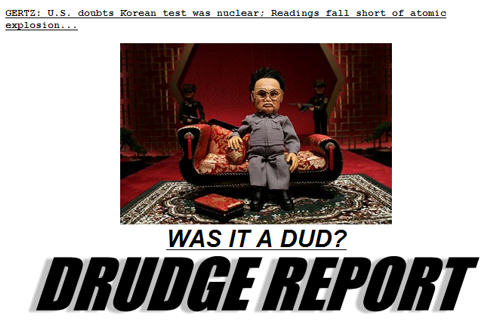
Jordan .
|
| 11. Tuesday, October 10, 2006 6:07 AM |
| Freshly Squeezed |
RE: North Korea Nukes |
Member Since
9/29/2006
Posts:275
View Profile
Send PM
|
Lol. Send in the Thunderbirds! The point made in Druge was suggested in the second article Susan cut and pasted. May be, just may be.
Beauty is momentary in the mind -
The fitful tracing of a portal;
But in the flesh it is immortal.
The body dies; the body's beauty lives.
So evenings die, in their green going,
A wave, interminably flowing.
So gardens die, their meek breath scenting
the cowl of winter, done repenting.
So maidens die, to the auroral
Celebration of a maiden's choral.
Susanna's music touched the bawdy strings
Of those white elders; but, escaping,
Left only Death's ironic scraping.
Now in its immortality, it plays
On the clear viol of her memory,
And makes a constant sacrement of praise. ('Peter Quince at the Clavier' by Wallace Stevens)
|
| 12. Tuesday, October 10, 2006 9:40 AM |
| nuart |
RE: North Korea Nukes |
Member Since
12/18/2005
Posts:7632
View Profile
Send PM
|
Thanks for that photo of "I'm so Ronery!" Yesterday I was searching for an image from that "You're blaking my barrs, Hans Brix!" shark tank scene from Team America but I couldn't find it. Gawd, I love that movie!!! Remember when wowBOBwow was posting about N.Korea and would remind us not to (mis)underestimate Kim Jung-Il? I try to take him seriously but every time I see some file footage of him, I'm a.) amazed, b.) amused and c.) curious about how a society reaches such depths of totalitarianism. It seems to go against all human nature to tolerate the conditions for so long. All societies have a shelf life -- good and bad -- so I know North Korea's demise is just a matter of time. But still... you look at him, the abandoned city streets, the perfect unison of the goose-stepping soldiers and you have to wonder how it meshes with the human spirit. Then I remember how the file footage of Osama and the Boys rock-climbing around the caves of Tora Bora and how hard it was to take them seriously. China's representative to the UN seemed a little non-commital today, doesn't he? We don't want to be too harsh. He seemed to have a little -- dare I say -- inscrutable smile on his face. Tepid reaction to the North Korean threat unless they don't really consider it a threat but only a part of the master plan. In which case, the US-Europe and the rest of Asia is also aware that North Korea is a small cog. Back in January of 2000, it was China on my mind. Not Al Qaeda. There have been many other earthshaking events since then. Even so I still believe the massive Chinese Dragon is carefully biding her time and may ultimately be the biggest threat of all. Their tolerance of North Korea's "nuclear" dynamite explosion may be part of their geo-political chess game and Kim Jung Il may be only a pawn in the game. Keep the world distracted; encourage/tolerate itty bitty starving "Axis of Evil" North Korea's 'nuclear' ambitions; ingratiate yourself with the world community as if your persuasion alone can finally get a handle on that rapscallion Kim Jung Il; allow your own masses more and more semblance of post-Tiannamen Square freedoms with Internet and consumerism and commerce; build your own military -- particularly your navy; take full advantage of the Super Power's declining efficacy due to costly wars; encourage international business ventures by manufacturing virtually every item sold in US stores; build your economy and your middle class thereby keeping them less than interested in politics and one day the Western World awakens to the New Boss. How will Kim Jung Il factor in at that point? Thanks for your help but you're now our slave. {{{snicker loudly}}} Of course the best laid plans, if this is any kind of a plan, often go awry. As Mickey Rourke once said: Anytime you try a decent crime, there's fifty ways to f*** up. If you think of twenty-five of them, you're a genius. And you're no genius.
Let's hope not. Susan
“Half a truth is often a great lie.” Ben Franklin
|
| 13. Tuesday, October 10, 2006 10:01 AM |
| LetsRoque |
RE: North Korea Nukes |
Member Since
1/2/2006
Posts:922
View Profile
Send PM
|
I find the whole N.korea regime alot like a Lynch film. So f*cked up yet extremely interesting. I mean, the people of N.Korea think we in the rest of the world are all poor and miserable and that they live in a paradise! Hundreds of thousands of N.koreans are living in total insulation and abject poverty, yet they think we have it bad! Hats off to their 'dear leader' for being able to contain such a docile population. It must take some effort.
'I look for an opening, do you understand?'
|
| 14. Wednesday, October 11, 2006 5:47 AM |
| jordan |
RE: North Korea Nukes |
Admin
Member Since
12/17/2005
Posts:2274
View Profile
Send PM
|
here's an interesting theory regarding Bush and N Korea. http://www.dailykos.com/story/2006/10/11/2049/1114 "I heard it on Al Franken this morning and it's frickin obvious. And the only conclusion here, and the only thing people really need be talking about (while they're taking a break from talking about Foleygate) is that Bush let North Korea get nukes in order to start an arms race in Asia. He did it so American weapons manufacturers will make money, like we do with Israel. We need to start talking straight, people. We need to start being up front about what this is all about. We can't wait until Bush walks up and blows our brains out to call this what it is." LOL!!!! Bush went back in time during Clinton's admin to help Kim make nuclear weapons. That's priceless.
Jordan .
|
|
New Topic |
Post Reply
|
Page 1 of 1 ::
<< |
1 |
>>
|
|
Politics
> North Korea Nukes
|
| Users viewing this Topic (0) |
| |
Powered by JorkelBB 2006 (Version 1.0b)
|
|
|


