|
|
|
|
|
| 26. Tuesday, January 17, 2006 5:08 PM |
| jordan |
RE: Iran |
Admin
Member Since
12/17/2005
Posts:2274
View Profile
Send PM
|
I stand corrected - I should've worded that better. Iraq never publicly said they had WMDs, but reports suggest that internally, either Saddam thought he had WMDs or said he had (knowing he didn't) which was what I was referring to in that above statement. Did you read that article I linked to?
Correct me if I'm wrong, but for about a year now you've been saying that the "real" threat is N Korea and Iran, it was not Iraq. Have you not said this either directly or inferred it on more than one occassion? Because I'm fairly sure you have, but I don't want to put words in your mouth.
Jordan .
|
| 27. Tuesday, January 17, 2006 5:22 PM |
| jordan |
RE: Iran |
Admin
Member Since
12/17/2005
Posts:2274
View Profile
Send PM
|
sorry about the double post but saw this and thought it would be fun to add to the mix. From Reuters: ------- WASHINGTON (Reuters) - A disruption in Iran's crude oil exports because of a dispute over that country's nuclear program would affect an already tight global oil market and lead to higher petroleum prices, the head of the U.S. Energy Information Administration warned on Tuesday. "The market is so tightly balanced, clearly, we can't afford to lose a large supply of crude to the market," EIA chief Guy Caruso told Reuters in an interview. Even though the United States does not directly import Iranian crude, Caruso said a cutoff of Iran's oil would affect the U.S. market because other countries that buy Iranian crude would compete with America to find new supplies. "It's a fungible world oil market, and any disruption in supply affects everyone, because the price would go up for everyone," he said. Caruso declined to say whether a disruption of Iran's oil exports would have an impact significant enough to spike oil prices to $100 a barrel. "I wouldn't want to speculate on that. Hopefully (the nuclear dispute) would be resolved without any disruption of supply," he said. ---
Jordan .
|
| 28. Tuesday, January 17, 2006 5:24 PM |
| wowBOBwow |
RE: Iran |
Member Since
12/20/2005
Posts:1136
View Profile
Send PM
|
I have in the past stated that the real and/or more serious threat MAY be Iran and N.Korea, usually in response to scoffing that neither one should have us raising an eyebrow. I was and am concerned that the conflict in Iraq has infected many Americans with tunnel vision. Anything is possible.
|
| 29. Tuesday, January 17, 2006 5:45 PM |
| jordan |
RE: Iran |
Admin
Member Since
12/17/2005
Posts:2274
View Profile
Send PM
|
Let's go down that road. Why do you think Iran (let's leave N Korea out of it since it is the one who I have scoffed about) is a possible (there's the MAY) threat? What makes you think so? Because the intelligence is not solid.
Jordan .
|
| 30. Tuesday, January 17, 2006 11:43 PM |
| nuart |
RE: Iran |
Member Since
12/18/2005
Posts:7632
View Profile
Send PM
|
Hate to throw another George Friedman into the mix right in the middle of the road we're goin' down, but this just came through on my email. George Friedman of Stratfor again. I do love the way he breaks down the onesies, twosies, threesies, etc. though. After reading this ask yourself the broader question of how many nation states have to compromise in order to survive and thrive. The answer is 100%. This chess game started long ago. I'm counting on our team to win it if some of the clumsy pawns don't trip us up on the way to the finish line.
See what we think about this one. Friedman may be dumb about the Valerie Plame "outing" story, but he is on target with his area of greater expertise - Iran. I found this article oddly reassuring!
Susan
January 17, 2006
Iran's Redefined Strategy By George Friedman
The Iranians have broken the International Atomic Energy Agency seals on some of their nuclear facilities. They did this very deliberately and publicly to make certain that everyone knew that Tehran was proceeding with its nuclear program. Prior to this, and in parallel, the Iranians began to -- among other things -- systematically bait the Israelis, threatening to wipe them from the face of the earth.
The question, of course, is what exactly the Iranians are up to. They do not yet have nuclear weapons. The Israelis do. The Iranians have now hinted that:
(a) they plan to build nuclear weapons... and have implied, as clearly as possible without saying it, that... (b) they plan to use them against Israel. On the surface, these statements appear to be begging for a pre-emptive strike by Israel. There are many things one might hope for, but a surprise visit from the Israeli air force is not usually one of them. Nevertheless, that is exactly what the Iranians seem to be doing, so we need to sort this out.
There are four possibilities:
1. Mahmoud Ahmadinejad, the Iranian president, is insane and wants to be attacked because of a bad childhood.
2. The Iranians are engaged in a complex diplomatic maneuver, and this is part of it.
3. The Iranians think they can get nuclear weapons -- and a deterrent to Israel -- before the Israelis attack.
4. The Iranians, actually and rationally, would welcome an Israeli -- or for that matter, American -- air strike.
Let's begin with the insanity issue, just to get it out of the way. One of the ways to avoid thinking seriously about foreign policy is to dismiss as a nutcase anyone who does not behave as you yourself would. As such, he is unpredictable and, while scary, cannot be controlled. You are therefore relieved of the burden of doing anything about him. In foreign policy, it is sometimes useful to appear to be insane, as it is in poker: The less predictable you are, the more power you have -- and insanity is a great tool of unpredictability. Some leaders cultivate an aura of insanity.
However, people who climb to the leadership of nations containing many millions of people must be highly disciplined, with insight into others and the ability to plan carefully. Lunatics rarely have those characteristics. Certainly, there have been sociopaths -- like Hitler -- but at the same time, he was a very able, insightful, meticulous man. He might have been crazy, but dismissing him because he was crazy -- as many did -- was a massive mistake. Moreover, leaders do not rise alone. They are surrounded by other ambitious people. In the case of Ahmadinejad, he is answerable to others above him (in this case, Ayatollah Ali Khamenei), alongside him and below him. He did not get to where he is by being nuts -- and even if we think what he says is insane, it clearly doesn't strike the rest of his audience as insane. Thinking of him as insane is neither helpful nor clarifying.
The Three-Player Game
So what is happening?
First, the Iranians obviously are responding to the Americans. Tehran's position in Iraq is not what the Iranians had hoped it would be. U.S. maneuvers with the Sunnis in Iraq and the behavior of Iraqi Shiite leaders clearly have created a situation in which the outcome will not be the creation of an Iranian satellite state. At best, Iraq will be influenced by Iran or neutral. At worst, it will drift back into opposition to Iran -- which has been Iraq's traditional geopolitical position. This is not satisfactory. Iran's Iraq policy has not failed, but it is not the outcome Tehran dreamt of in 2003.
There is a much larger issue. The United States has managed its position in Iraq -- to the extent that it has been managed -- by manipulating the Sunni-Shiite fault line in the Muslim world. In the same way that Richard Nixon manipulated the Sino-Soviet split, the fundamental fault line in the Communist world, to keep the Soviets contained and off-balance late in the Vietnam War, so the Bush administration has used the primordial fault line in the Islamic world, the Sunni-Shiite split, to manipulate the situation in Iraq.
Washington did this on a broader scale as well. Having enticed Iran with new opportunities -- both for Iran as a nation and as the leading Shiite power in a post-Saddam world -- the administration turned to Sunni countries like Saudi Arabia and enticed them into accommodation with the United States by allowing them to consider the consequences of an ascended Iran under canopy of a relationship with the United States. Washington used that vision of Iran to gain leverage in Saudi Arabia. The United States has been moving back and forth between Sunnis and Shia since the invasion of Afghanistan, when it obtained Iranian support for operations in Afghanistan's Shiite regions. Each side was using the other. The United States, however, attained the strategic goal of any three-player game: It became the swing player between Sunnis and Shia.
This was not what the Iranians had hoped for.
Reclaiming the Banner
There is yet another dimension to this. In 1979, when the Ayatollah Ruholla Khomeini deposed the Shah of Iran, Iran was the center of revolutionary Islamism. It both stood against the United States and positioned itself as the standard-bearer for radical Islamist youth. It was Iran, through its creation, Hezbollah, that pioneered suicide bombings. It championed the principle of revolutionary Islamism against both collaborationist states like Saudi Arabia and secular revolutionaries like Yasser Arafat. It positioned Shi'ism as the protector of the faith and the hope of the future.
In having to defend against Saddam Hussein's Iraq in the 1980s, and the resulting containment battle, Iran became ensnared in a range of necessary but compromising relationships. Recall, if you will, that the Iran-Contra affair revealed not only that the United States used Israel to send weapons to Iran, but also that Iran accepted weapons from Israel. Iran did what it had to in order to survive, but the complexity of its operations led to serious compromises. By the late 1990s, Iran had lost any pretense of revolutionary primacy in the Islamic world. It had been flanked by the Sunni Wahhabi movement, al Qaeda.
The Iranians always saw al Qaeda as an outgrowth of Saudi Arabia and Pakistan and therefore, through Shiite and Iranian eyes, never trusted it. Iran certainly didn't want al Qaeda to usurp the position of primary challenger to the West. Under any circumstances, it did not want al Qaeda to flourish. It was caught in a challenge. First, it had to reduce al Qaeda's influence, or concede that the Sunnis had taken the banner from Khomeini's revolution. Second, Iran had to reclaim its place. Third, it had to do this without undermining its geopolitical interests.
Tehran spent the time from 2003 through 2005 maximizing what it could from the Iraq situation. It also quietly participated in the reduction of al Qaeda's network and global reach. In doing so, it appeared to much of the Islamic world as clever and capable, but not particularly principled. Tehran's clear willingness to collaborate on some level with the United States in Afghanistan, in Iraq and in the war on al Qaeda made it appear as collaborationist as it had accused the Kuwaitis or Saudis of being in the past. By the end of 2005, Iran had secured its western frontier as well as it could, had achieved what influence it could in Baghdad, had seen al Qaeda weakened. It was time for the next phase. It had to reclaim its position as the leader of the Islamic revolutionary movement for itself and for Shi'ism.
Thus, the selection of the new president was, in retrospect, carefully engineered. After President Mohammed Khatami's term, all moderates were excluded from the electoral process by decree, and the election came down to a struggle between former President Ali Akbar Hashemi Rafsanjani -- an heir to Khomeini's tradition, but also an heir to the tactical pragmatism of the 1980s and 1990s -- and Ahmadinejad, the clearest descendent of the Khomeini revolution that there was in Iran, and someone who in many ways had avoided the worst taints of compromise.
Ahmadinejad was set loose to reclaim Iran's position in the Muslim world. Since Iran had collaborated with Israel during the 1980s, and since Iranian money in Lebanon had mingled with Israeli money, the first thing he had to do was to reassert Iran's anti-Zionist credentials. He did that by threatening Israel's existence and denying the Holocaust. Whether he believed what he was saying is immaterial. Ahmadinejad used the Holocaust issue to do two things: First, he established himself as intellectually both anti-Israeli and anti-Jewish, taking the far flank among Islamic leaders Second, he signaled a massive breach with Khatami's approach.
Khatami was focused on splitting the Western world by dividing the Americans from the Europeans. In carrying out this policy, he had to manipulate the Europeans. The Europeans were always open to the claim that the Americans were being rigid and were delighted to serve the role of sophisticated mediator. Khatami used the Europeans' vanity brilliantly, sucking them into endless discussions and turning the Iran situation into a problem the Europeans were having with the United States.
But Tehran paid a price for this in the Muslim world. In drawing close to the Europeans, the Iranians simply appeared to be up to their old game of unprincipled realpolitik with people -- Europeans -- who were no better than the Americans. The Europeans were simply Americans who were weaker. Ahmadinejad could not carry out his strategy of flanking the Wahhabis and still continue the minuet with Europe. So he ended Khatami's game with a bang, with a massive diatribe on the Holocaust and by arguing that if there had been one, the Europeans bore the blame. That froze Germany out of any further dealings with Tehran, and even the French had to back off. Iran's stock in the Islamic world started to rise.
The Nuclear Gambit
The second phase was for Iran to very publicly resume -- or very publicly claim to be resuming -- development of a nuclear weapon. This signaled three things:
1. Iran's policy of accommodation with the West was over.
2. Iran intended to get a nuclear weapon in order to become the only real challenge to Israel and, not incidentally, a regional power that Sunni states would have to deal with.
3. Iran was prepared to take risks that no other Muslim actor was prepared to take. Al Qaeda was a piker.
The fundamental fact is that Ahmadinejad knows that, except in the case of extreme luck, Iran will not be able to get nuclear weapons. First, building a nuclear device is not the same thing as building a nuclear weapon. A nuclear weapon must be sufficiently small, robust and reliable to deliver to a target. A nuclear device has to sit there and go boom. The key technologies here are not the ones that build a device but the ones that turn a device into a weapon -- and then there is the delivery system to worry about: range, reliability, payload, accuracy. Iran has a way to go.
A lot of countries don't want an Iranian bomb. Israel is one. The United States is another. Throw Saudi Arabia, Turkey, and most of the 'Stans into this, and there are not a lot of supporters for an Iranian bomb. However, there are only two countries that can do something about it. The Israelis don't want to get the grief, but they are the ones who cannot avoid action because they are the most vulnerable if Iran should develop a weapon. The United States doesn't want Israel to strike at Iran, as that would massively complicate the U.S. situation in the region, but it doesn't want to carry out the strike itself either.
This, by the way, is a good place to pause and explain to readers who will write in wondering why the United States will tolerate an Israeli nuclear force but not an Iranian one. The answer is simple. Israel will probably not blow up New York. That's why the United States doesn't mind Israel having nukes and does mind Iran having them. Is that fair? This is power politics, not sharing time in preschool. End of digression.
Intra-Islamic Diplomacy
If the Iranians are seen as getting too close to a weapon, either the United States or Israel will take them out, and there is an outside chance that the facilities could not be taken out with a high degree of assurance unless nukes are used. In the past, our view was that the Iranians would move carefully in using the nukes to gain leverage against the United States. That is no longer clear. Their focus now seems to be not on their traditional diplomacy, but on a more radical, intra-Islamic diplomacy. That means that they might welcome a (survivable) attack by Israel or the United States. It would burnish Iran's credentials as the true martyr and fighter of Islam.
Meanwhile, the Iranians appear to be reaching out to the Sunnis on a number of levels. Muqtada al-Sadr, the leader of a radical Shiite group in Iraq with ties to Iran, visited Saudi Arabia recently. There are contacts between radical Shia and Sunnis in Lebanon as well. The Iranians appear to be engaged in an attempt to create the kind of coalition in the Muslim world that al Qaeda failed to create. From Tehran's point of view, if they get a deliverable nuclear device, that's great -- but if they are attacked by Israel or the United States, that's not a bad outcome either.
In short, the diplomacy that Iran practiced from the beginning of the Iraq-Iran war until after the U.S. invasion of Iraq appears to be ended. Iran is making a play for ownership of revolutionary Islamism on behalf of itself and the Shia. Thus, Tehran will continue to make provocative moves, while hoping to avoid counterstrikes. On the other hand, if there are counterstrikes, the Iranians will probably be able to live with that as well.
“Half a truth is often a great lie.” Ben Franklin
|
| 31. Wednesday, January 18, 2006 7:43 AM |
| jordan |
RE: Iran |
Admin
Member Since
12/17/2005
Posts:2274
View Profile
Send PM
|
I want to copy and paste a pargraph because I think it really needs to stand out: "This, by the way, is a good place to pause and explain to readers who will write in wondering why the United States will tolerate an Israeli nuclear force but not an Iranian one. The answer is simple. Israel will probably not blow up New York. That's why the United States doesn't mind Israel having nukes and does mind Iran having them. Is that fair? This is power politics, not sharing time in preschool. End of digression." Right on target! There's so much sabre-rattling going on right now that it's hard to really see anything clear. You have a potential growing threat, but at the same time, taking action may very well have bigger implications than we realize. For example: If Israel attacks the plants by themselves, then I think we can kiss a peace accord that we've been seeing lately goodbye. and with Sharon out of power now, their own leadership is up for grabs, so I really don't see Israel taking action until they have a new leader. That leaves us with the US.
If the US attacks (easy to do with bases in Iraq and some ships in the Persian Gulf right now), then not only will the peace accord disappear (because the Muslim world will blame Israel), but those who believe that the US attacked for religious reasons will increase dramatically causing a bigger Religious Cold War that I think we have begun to see grow even stronger. The US does not have the clout or the man-power to invade, but the US does have the man-power (but maybe not the clout) to take out a nuclear power plant. Too bad the US doesn't have an ally who is an enemy of Iran (besides Israel) in the Middle East who would be willing to take care of this for everyone. Pakistan might be the only country who could attack (with the asistance of the US) and not have any major repercussions externally, but internally, I think we would see the fall of Musharrif (sp?). Talk about a sticky situation.
Jordan .
|
| 32. Wednesday, January 18, 2006 8:07 AM |
| jordan |
RE: Iran |
Admin
Member Since
12/17/2005
Posts:2274
View Profile
Send PM
|
double post, but here's an editorial that not only goes after Europe for its weak attempt at talkign with Iran, but also gives us a harsh look at what both sanctions and what an attack might bring the world to - an economic crisis. The Iran Charade, Part II
By Charles Krauthammer ``It was what made this EU Three approach so successful. They (Britain, France and Germany) stood together and they had one uniform position.' -- German Chancellor Angela Merkel, Jan. 13, 2006 WASHINGTON -- Makes you want to weep. One day earlier, Britain, France and Germany admitted that their two years of talks to stop Iran's nuclear weapons program had collapsed. The Iranians had broken the seals on their nuclear facilities and were resuming activity in defiance of their pledges to the EU Three. This negotiating exercise, designed as an alternative to the U.S. approach of sanctioning Iran for its violations of the Non-Proliferation Treaty, had proved entirely futile. If anything, the two-year hiatus gave Iran time to harden its nuclear facilities against bombardment, acquire new antiaircraft capacities and clandestinely advance its program. With all this, the chancellor of Germany declares the exercise a success because the allies stuck together! The last such success was Dunkirk. Lots of solidarity there too. Most dismaying was that this assessment comes from a genuinely good friend, the new German chancellor, who, unlike her predecessor, Gerhard Schroeder (now a wholly owned Putin flunky working for Russia's state-run oil monopoly), actually wants to do something about terrorism and nuclear proliferation. Ah, success. Instead of being years away from the point of no return for an Iranian bomb, as we were before we allowed Europe to divert anti-proliferation efforts into transparently useless talks, Iran is probably just months away. And now, of course, Iran is run by an even more radical government, led by a president who fervently believes in the imminence of the apocalypse. Ah, success. Having delayed two years, we now have to deal with a set of fanatical Islamists that we know in advance will not be deterred from pursuing nuclear weapons by any sanctions. Even if we could get real sanctions. Which we will not. The last remaining months before Iran goes nuclear are about to be frittered away in pursuit of this newest placebo. First, because Russia and China will threaten to veto any serious sanctions. The Chinese in particular have secured in Iran a source of oil and gas outside the American sphere to feed their growing economy and are quite happy geopolitically to support a rogue power that -- like North Korea -- threatens, distracts and diminishes the power of China's chief global rival, the United States. (Jordan note - the reality that we live in a world where "allies" don't have the best interest of the world at heart which some people often forget)
Second, because the Europeans have no appetite for real sanctions either. A travel ban on Iranian leaders would be a joke; they don't travel anyway. A cutoff of investment and high-tech trade from Europe would be a minor irritant to a country of 70 million people with the second largest oil reserves in the world and with oil at $60 a barrel. North Korea tolerated 2 million dead from starvation to get its nuclear weapons. Iran will tolerate a shortage of flat-screen TVs. The only sanctions that might conceivably have any effect would be a boycott of Iranian oil. No one is even talking about that because no one can bear the thought of the oil shock that will instantly follow taking 4.2 million barrels a day off the market. (Jordan's Note - nope, we don't need to be searching for our own immediate oil supply - nope, not at all - let's just keep talking about alternative fuels that are years in teh future.)
Indeed, the threat here works in reverse. It is the Iranians who have the world over a barrel. On Jan. 15, Iran's economy minister warned that Iran would retaliate for any sanctions by cutting its exports to ``raise oil prices beyond levels the West expects.' A full cutoff could bring $100 oil and plunge the world into economic crisis. Which is one of the reasons the Europeans are so mortified by the very thought of a military strike against Iran's nuclear facilities. The problem is not just that they are spread out and hardened, making them difficult to find and to damage sufficiently to seriously set back Iran's program. The problem that mortifies the Europeans is what Iran might do after such an attack -- not just cut off its own oil exports but shut down the Strait of Hormuz (through which nearly half of the world's export oil passes) by firing missiles at tankers or scuttling its own vessels to make the strait impassable. It would require an international armada led by the United States to break such a blockade. Such consequences -- serious economic disruption and possible naval action -- are something a cocooned, aging, post-historic Europe cannot even contemplate. Which is why the Europeans have had their heads in the sand for two years. And why they will spend the little time remaining -- before a group of apocalyptic madmen go nuclear -- putting their heads back in the sand. And congratulating themselves on allied solidarity as they do so in unison. --------------
Jordan .
|
| 33. Monday, January 23, 2006 5:18 PM |
| gavincallaghan |
RE: Iran |
Member Since
1/7/2006
Posts:251
View Profile
Send PM
|
For the past six years, President Bush and his advisors have been publically advancing an agenda of increased reliance upon nuclear weapons and power, an agenda which necessarily involves the creation of more new nuclear power plants within the U.S. while at the same time breaking important international treaties. What a surprise, then, it is to hear the current and threatening "no-nuke" policies which are coming from Bush and Rice in Washington, as regards Iran's nascent attempts at advancing their own domestic nuclear policy. In language mirroring the "nuclear-freeze" talk of radical, long-haired Bolsheviks of the Cold War era, Bush and Rice seem rather alarmed to see nuclear weapons in the possession of the Iranian fundamentalist and militaristic regime. In truth, by choosing the path toward nuclear weapons and nuclear power, the Iranians are merely and fumblingly following the same path to destruction which has first been charted by Bush and Rice themselves, so that rather than setting a new standard for enlightenment and peace, the U.S., under Bush, is instead leading the way toward greater danger, greater international belligerance, and greater instability, to the detriment of our own future security. ---It is not hard to see, also, in the current Iranian decision to appoint a committee to investigate the "validity" of the Holocaust during WWII, some of the same historical and scientific revisionism which characterizes the Bush regime's own unscientific attitudes toward global warming, environmental destruction, energy policy, and birth control.
"There are no hereditary kings in America and no powers not created by the Constitution."--US District Judge Anna Diggs Taylor in her ruling against the Bush administration’s warrantless surveillance program "My French is poor, but my heart is rich. I love France- the art-making, art-loving, and art-supporting people of France." -David Lynch
|
| 34. Monday, January 23, 2006 5:38 PM |
| jordan |
RE: Iran |
Admin
Member Since
12/17/2005
Posts:2274
View Profile
Send PM
|

I'm surprised no one had any comments on the Krauthammer editorial above.
Jordan .
|
| 35. Monday, January 23, 2006 6:26 PM |
| danwhy |
RE: Iran |
Member Since
12/18/2005
Posts:1923
View Profile
Send PM
|
Quote:The only sanctions that might conceivably have any effect would be a boycott of Iranian oil. No one is even talking about that because no one can bear the thought of the oil shock that will instantly follow taking 4.2 million barrels a day off the market. (Jordan's Note - nope, we don't need to be searching for our own immediate oil supply - nope, not at all - let's just keep talking about alternative fuels that are years in teh future.)
Here's a comment, stop "talking" about alternative energy supplies and do something today, that's a step everyone is too chicken to take for some reason. Hyrbrid technology for instance is available now, so just mandate it on all cars manufactured now, there's a comment. I guess it's more fun though worry about Iran. If Clinton hadn't been chicken you would have alternative energy already. If Bush hadn't been too chicken for 6 years you would still be able to have alternative energy by today. Someone has to make this decision now.
"We cannot allow a mine shaft gap"
|
| 36. Wednesday, January 25, 2006 12:40 PM |
| nuart |
RE: Iran |
Member Since
12/18/2005
Posts:7632
View Profile
Send PM
|
Iran, in the form of one of its generals, allows his motor mouth to operate on full tilt boogie with this latest threat.  Susan Iran: We'll put Israel in 'eternal coma'
By ASSOCIATED PRESS
TEHERAN, IRAN
Were Israel to attack Iran's nuclear facilities, Iran would respond so strongly that it would put the Jewish state into "an eternal coma" like Prime Minister Ariel Sharon's, the Iranian defense minister said Wednesday.
"Zionists should know that if they do anything evil against Iran, the response of Iran's armed forces will be so firm that it will send them into eternal coma, like Sharon," Gen. Mostafa Mohammad Najjar said.
Najjar said the United States and Israel have been trying to frighten Iran, but neither country would dare attack to Iran.
Earlier Wednesday, Iran's president blamed Britain and the United States for two bombings that killed at least nine people in the southwestern city of Ahvaz on Tuesday. (Boy, I hope he's right about that! As I recall, earlier I made mention of the fact that we might be doing some quiet behind-the-scenes covert attacking.)
"Traces of the occupiers of Iraq is evident in the Ahvaz events. They should take responsibility in this regard," state television quoted President Mahmoud Ahmadinejad as saying.
The station reported that Ahmadinejad had issued a decree ordering his foreign minister and intelligence minister to investigate the possibility that "foreign hands" might have been responsible for the explosions.
At least nine people were killed in Tuesday's two blasts in Ahvaz, the capital of the oil-rich Khuzestan province which borders Iraq, police spokesman Mohammed Ali Pour said Wednesday.
According to the official Islamic Republic News Agency, 46 people were wounded in the explosions, which took place inside a bank and outside a state environmental agency building.
Ahvaz has a history of violence involving members of Iran's Arab minority. Last year, bombings in June and October killed a total of 14 people in the city. In April, residents rioted for two days over claims, denied by the government, that the state was planning to reduce the number of Arabs in the area. (OR, maybe it's the Arabs??? When a choice is presented to blame an Arab Muslim who is the more likely perp, it's always a good rule of thumb to suggest the Real Perp is the USA or Britain. Or Israel. Or the Mossad. Or the Jews.)
Iran has repeatedly accused Britain of provoking unrest in the region, which borders Iraq near where 8,500 British soldiers are based.
Britain has denied any connection to the Khuzestan unrest.
“Half a truth is often a great lie.” Ben Franklin
|
| 37. Wednesday, January 25, 2006 2:15 PM |
| jordan |
RE: Iran |
Admin
Member Since
12/17/2005
Posts:2274
View Profile
Send PM
|
Not all of us believe that govt should be putting its nose into the free market and mandating certain things, like requiring hybrid engines on all cars (Bush would be one of those people). I know that concept might be hard to grasp for some people, but some of us think that the govt should let the free market truly be free as it can be. Once demand increases for bybrids, then we'll start seeing a shift there. Meanwhile, we need to find oil resources at home that are not within the clutches of OPEC. Plus mandating hybrid engines requier more than mandating car companies. You then have to mandate a slew of gas statiosn and companies to require electric "fill-up" alongside with normal gas. So suddenly you have not only an increase in car prices, but also an increase in gas/electric prices at the pump (they have to pass the price on to the consumer, don't they?). I expect hybrids to pick up within 5 years - see this article http://autos.msn.com/advice/article.aspx?contentid=4023397&src=LP%20Hybrid That's the free market for you, and as a result there's no need for a govt mandate.
Jordan .
|
| 38. Thursday, January 26, 2006 1:04 AM |
| danwhy |
RE: Iran |
Member Since
12/18/2005
Posts:1923
View Profile
Send PM
|
But in the meantime you need to dig up Alaska or buy from Iran, that's great while the free market decides itself isn't it. Oh well, at least Alberta is going to get very very very rich.
"We cannot allow a mine shaft gap"
|
| 39. Thursday, January 26, 2006 6:07 AM |
| jordan |
RE: Iran |
Admin
Member Since
12/17/2005
Posts:2274
View Profile
Send PM
|
You sound like the Bush admin is wanting to dig up all of Alaska wihch is furtherst from the truth. And no, we don't have to just dig up Alaska. There's plenty of other ideas - open up the Gulf waters to more exploration. Put windmills out in the coasts to help reduce eletrical power by coal. The latter is an option up in Massachusettes, but Ted Kennedy and John Kerry are against this because it will ruin the historical view. Ther's also something about making certain geographic formations that we have a lot of into a oil. I forget the details but the process was somewhat expensive for the past few years but now the price of oil makes this process more affordable. There are all sorts of different things the US can do besides mandating hybrid engines which will have a direct financial impact on companies, workers and consumers until we can create a more efficient alternate fuel source.
Jordan .
|
| 40. Thursday, January 26, 2006 3:51 PM |
| nuart |
RE: Iran |
Member Since
12/18/2005
Posts:7632
View Profile
Send PM
|
Who knows if this article from Al Jazeera belongs with the Hamas thread or here in Iran? Well, like so much in the region, they overlap in the worst way. Oddly, I think the Iranian people have very little personal regard for Arabs, let alone Palestinian Arabs. While Ahmadinejad suggests that Europe take in the Jews of Israel, notice the glaring absence of welcome to any Palestinian refugees to Muslim countries over the past half century? The Palestinians are pawns in a larger and more lethal game of international geo-politics. Meanwhile the celebratory gunfire goes on with the crowds outside the Ramallah compound of the Palestinian Authority behaving as if they're at a martyr's funeral or something.
Susan
_____________________________________________________ Iran hails Hamas victory
Thursday 26 January 2006 1:55 PM GMT
Iran has congratulated the Islamist Palestinian group Hamas for its election victory and praised voters for choosing "to continue the struggle and resistance against occupation".
Hamid Reza Asefi, the foreign ministry spokesman said in a statement on Thursday faxed to journalists:"The Islamic republic of Iran congratulates Hamas and all the Palestinian soldiers and the great Islamic people."
Iran and Hamas are allies and declared in December that they represented a "united front" against Israel. "The Palestinians have voted for the resistance and have shown their loyalty," Asefi said. (THERE IT IS! A UNITED FRONT. LOYALTY? TO WHOM??? TO WHAT???)
"The result of these elections will reinforce the unity of the Palestinian people in defending their rights. The massive participation of the Palestinians shows their will to continue the struggle and resistance against occupation."
Although Iran is a vocal supporter of Hamas - as well as the Palestinian resitance group Islamic Jihad and the Lebanese Shia movement Hizb Allah - the clerical regime denies allegations it finances these groups. (I trust the clerical regime"s denials. They wouldn't like about a thing like that, would they?)
Allies
But on 15 December, Khaled Meshaal, the Hamas political chief said during a visit to the Iranian capital that his group would step up attacks against Israel if the Jewish state took military action against Iran over its disputed nuclear programme.
"Just as Islamic Iran defends the rights of the Palestinians, we defend the rights of Islamic Iran. We are part of a united front against the enemies of Islam," Meshaal said during the visit.
"Each member of this front defends itself with its own means in its region. We carry the battle in Palestine. If Israel launches an attack against Iran, we will expand the battlefield in Palestine," he said. (That's a little confusing. I think they refer to "Israel" aka "the Zionist Entity" as the Jewish people who happen to live in Palestine.)
Anti-occupation
"We are part of a united front, and if one member of this front is attacked it is our duty to support them," he added, also praising Mahmoud Ahmadinejad, the Iranian President, for his "courageous" anti-Israeli stance.
Since sweeping to power in a shock election win last June, Ahmadinejad has embarked on an all-out verbal assault against Israel.
He has labelled the Jewish state as a "tumour" that should be "wiped off the map" or moved as far away as Alaska, and has branded the Holocaust a "myth".
____________________________________________________ Al Jazeera's poll on the subject so far. You can guess where my vote landed.
Will Palestinian elections augur well for Middle East peace? YES: 41% NO: 59% Number of pollers: 11064
“Half a truth is often a great lie.” Ben Franklin
|
| 41. Thursday, January 26, 2006 5:21 PM |
| jordan |
RE: Iran |
Admin
Member Since
12/17/2005
Posts:2274
View Profile
Send PM
|
Let's also not forget that it's believed that Iran finances Hamas. So not only do you have an established govt of Iran threatening the destruction of Israel, but who have their "employees" on the other side with the same concepts who are now an "official govt."
Jordan .
|
| 42. Friday, January 27, 2006 10:22 PM |
| danwhy |
RE: Iran |
Member Since
12/18/2005
Posts:1923
View Profile
Send PM
|
An interesting read from Fortune which relates to our sort of off topic oil discussion: Ready for $262/barrel oil? Two of the world's most successful investors say oil will be in short supply in the coming months. DAVOS, Switzerland (FORTUNE) - Be afraid. Be very afraid. That's the message from two of the world's most successful investors on the topic of high oil prices. One of them, Hermitage Capital's Bill Browder, has outlined six scenarios that could take oil up to a downright terrifying $262 a barrel. The other, billionaire investor George Soros, wouldn't make any specific predictions about prices. But as a legendary commodities player, it's worth paying heed to the words of the man who once took on the Bank of England -- and won. "I'm very worried about the supply-demand balance, which is very tight," Soros says. "U.S. power and influence has declined precipitously because of Iraq and the war on terror and that creates an incentive for anyone who wants to make trouble to go ahead and make it." As an example, Soros pointed to the regime in Iran, which is heading towards a confrontation with the West over its nuclear power program and doesn't show any signs of compromising. "Iran is on a collision course and I have a difficulty seeing how such a collision can be avoided," he says. Another emboldened troublemaker is Russian president Vladimir Putin, Soros said, citing Putin's recent decision to briefly shut the supply of natural gas to Ukraine. The only bit of optimism Soros could offer was that the next 12 months would be most dangerous in terms of any price shocks, because beginning in 2007 he predicts new oil supplies will come online. Hermitage's Bill Browder doesn't yet have the stature of George Soros. But his $4 billion Moscow-based Hermitage fund rose 81.5 percent last year and is up a whopping 1780 percent since its inception a decade ago. A veteran of Salomon Bros. and Boston Consulting Group, the 41-year old Browder has been especially successful because of his contrarian take; for example, he continued to invest in Russia when others fled following the Kremlin's assault on Yukos. Doomsdays 1 through 6 To come up with some likely scenarios in the event of an international crisis, his team performed what's known as a regression analysis, extrapolating the numbers from past oil shocks and then using them to calculate what might happen when the supply from an oil-producing country was cut off in six different situations. The fall of the House of Saud seems the most far-fetched of the six possibilities, and it's the one that generates that $262 a barrel. More realistic -- and therefore more chilling -- would be the scenario where Iran declares an oil embargo a la OPEC in 1973, which Browder thinks could cause oil to double to $131 a barrel. Other outcomes include an embargo by Venezuelan strongman Hugo Chavez ($111 a barrel), civil war in Nigeria ($98 a barrel), unrest and violence in Algeria ($79 a barrel) and major attacks on infrastructure by the insurgency in Iraq ($88 a barrel). Regressions analysis may be mathematical but it's an art, not a science. And some of these scenarios are quite dubious, like Venezuela shutting the spigot. (For more on Chavez and Venezuela, click here.) Energy chiefs at the World Economic Forum in Davos downplayed the likelihood of a serious oil shortage. In a statement Friday, Shell's CEO Jeroen Van der Veer declared, "There is no reason for pessimism." OPEC Acting Secretary General Mohammed Barkindo said "OPEC will step in at any time there is a shortage in the market." But then no one in the industry, including Van der Veer, foresaw an extended run of $65 oil -- or even $55 oil -- like we've been having. It's clear that there is very, very little wiggle room, and that most consumers, including those in the United States, have acceded so far to the new reality of $60 or even $70 oil. And as Soros points out, the White House has its hands full in Iraq and elsewhere. Although there are long-term answers like ethanol, what's needed is a crash conservation effort in the United States. This doesn't have to be command-and-control style. Moral suasion counts for a lot, and if the president suggested staying home with family every other Sunday or otherwise cutting back on unnecessary drives, he could please the family values crowd while also changing the psychology of the oil market by showing that the U.S. government is serious about easing any potential bottlenecks. Similarly, he could finally get the government to tighten fuel-efficiency standards and encourage both Detroit and drivers to end decades of steadily increasing gas consumption. These kinds of steps would create a little headroom until new supplies do become available or threats like Iran's current leadership or the Iraqi insurgency fade. It's been done it before. For all the cracks about Jimmy Carter in a cardigan and his malaise speech, America did reduce its use of oil following the price shocks of the 1970s, and laid the groundwork for low energy prices in the 1980s and 1990s. But it would require spending political capital, and offending traditional White House allies, and that's something this president doesn't seem to want to do.
"We cannot allow a mine shaft gap"
|
| 43. Tuesday, February 7, 2006 5:56 PM |
| jordan |
RE: Iran |
Admin
Member Since
12/17/2005
Posts:2274
View Profile
Send PM
|
Deleted Gavin's post who posted under a different username. Gavin - one user only please.
Jordan .
|
| 44. Tuesday, February 7, 2006 6:23 PM |
| nuart |
RE: Iran |
Member Since
12/18/2005
Posts:7632
View Profile
Send PM
|
QUOTE:Deleted Gavin's post who posted under a different username. Gavin - one user only please.
|
Oh, man, and before I got a chance to read it!?! You meanie, Jordan! Susan
“Half a truth is often a great lie.” Ben Franklin
|
| 45. Tuesday, February 7, 2006 6:28 PM |
| jordan |
RE: Iran |
Admin
Member Since
12/17/2005
Posts:2274
View Profile
Send PM
|
It was a C&P from www.democracynow.org - note the slogan in their website's header: "Indepdent..media." And people criticize FNC for lying with regards to their slogan 
Jordan .
|
| 46. Saturday, February 11, 2006 3:26 PM |
| nuart |
RE: Iran |
Member Since
12/18/2005
Posts:7632
View Profile
Send PM
|
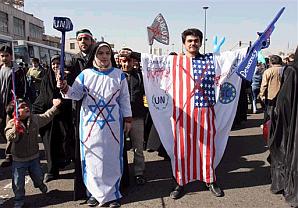
You gotta love the chutzpah of this Ahmadinejad! Here's his latest Jew-phobic statement. Feeling his oats, this wee little fella! Susan Ahmadinejad: Israel 'will be removed' An Iranian couple protest whilst decorated with defaced US and Israeli flags as they attend a demonstration to mark the 27th anniversary of the Islamic Revolution, in Tehran.
Photo: AP
Tehran (dpa) - Iranian President Mahmoud Ahmadinejad said on Saturday that the Palestinians and "other nations" will eventually remove Israel from the region.
Addressing a mass demonstration in Tehran - one of many organized throughout Iran to commemorate the 27th anniversary of the Islamic revolution - he once again questioned the Holocaust "fairy tale".
"We ask the West to remove what they created sixty years ago and if they do not listen to our recommendations, then the Palestinian nation and other nations will eventually do this for them," Ahmadinejad said in a ceremony marking the 27th anniversary of the Islamic revolution.
"Do the removal of Israel before it is too late and save yourself from the fury of regional nations," the ultra-conservative president said. He once again called the Holocaust a "fairy tale" and said Europeans have become hostages of "Zionists" in Israel.
He also accused Europeans for not allowing "neutral scholars" to investigate in Europe and make a scientific report on "the truth about the fairy tale of Holocaust."
"How comes that insulting the prophet of Muslims worldwide is justified within the framework of press freedom, but investigating about the fairy tale Holocaust is not?" Ahmadinejad said.
"The real Holocaust is what is happening in Palestine where the Zionists avail themselves of the fairy tale of Holocaust as blackmail and justification for killing children and women and making innocent people homeless," Ahmadinejad said.
The president said that the results of the parliamentary elections in Palestine and the victory of the Hamas group "clearly showed what the people really want."
"You (the West) want democracy but do not respect the outcome," Ahmadinejad said, referring to the election results in Iraq and Palestine.
"It seems that you (the West) only want that form of democracy whose results just repeat your standpoints and only follow your policies," he said.
Ahmadinejad once again called on the West to adopt the "simple option" and allow Palestinians to voice their political will through a referendum.
Mass demonstrations organized by the state were held throughout Iran on Saturday as the nation commemorated the 27th anniversary of the revolution that established the Islamic Republic in Iran.
According to state media, hundreds of thousands of people came into the streets to show their solidarity with the government over pursuing the country's nuclear programmes and voice their protest against publication of cartoons deemed insulting to the Prophet Mohammed.
While chanting "Death to America", "Death of Israel" and "Nuclear energy is our undisputable right", the crowd walked toward the Azadi (Freedom) Square in Tehran where Ahmadinejad held his annual speech.
In his speech the Iranian president warned that in case of harsh measures against Tehran over its controversial nuclear programme, the country would revise its commitment toward the Nuclear Non- Proliferation Treaty (NPT).
"The policy of Iran has so far been pursuing nuclear technology within the framework of the NPT and IAEA (International Atomic Energy Agency)," he said.
"But if you (the West) continue efforts to deprive the Iranian nation from this (nuclear) right, then we would reconsider this policy," he warned.
Ahmadinejad asked the crowd in the Azadi square to tell the world its message and show its willingness to continue the nuclear programmes despite Western pressure.
"The era of military force is over, today is the era of nations, logic and worshippers of God," the president said.
He also referred to remarks by United States President George W. Bush who had said that the Iranian people were different from the Islamic government in Tehran, saying there was no distinction.
"Look, this is the third generation standing here and they are even more religious, more informed, more enthusiastic and more resistant (than the first generation) to defend the ideals of the revolution," Ahmadinejad said.
The president also referred to the cartoons and called it a "Zionist plot" against not only Muslims but also those genuinely committed to Christianity and Judaism.
"Those who insulted the prophet should know that you cannot obscure the sun with a handful of dust. The dust will just get back and blind your own eyes," he said.
The crowd replied to his remarks with "Death to Denmark" slogans.
“Half a truth is often a great lie.” Ben Franklin
|
| 47. Sunday, February 12, 2006 6:20 AM |
| jordan |
RE: Iran |
Admin
Member Since
12/17/2005
Posts:2274
View Profile
Send PM
|
I like their clothes!!! Sure hope they take those clothes off before burning the flags.
Jordan .
|
| 48. Sunday, February 12, 2006 6:37 AM |
| jordan |
RE: Iran |
Admin
Member Since
12/17/2005
Posts:2274
View Profile
Send PM
|
Sorry for the double post but saw the below article and thought peple might be interested: From the Telegraph "Strategists at the Pentagon are drawing up plans for devastating bombing raids backed by submarine-launched ballistic missile attacks against Iran's nuclear sites as a "last resort" to block Teheran's efforts to develop an atomic bomb. Central Command and Strategic Command planners are identifying targets, assessing weapon-loads and working on logistics for an operation, the Sunday Telegraph has learnt. ...." Take this however you like.
Jordan .
|
| 49. Monday, February 13, 2006 3:30 PM |
| nuart |
RE: Iran |
Member Since
12/18/2005
Posts:7632
View Profile
Send PM
|
Click on the link below and watch the despicable Ahmadinejad preaching to a massive Iranian crowd. It's a great advantage to live in an age where this sort of opportunity is available over the internet complete with translations into English. See if you think he's serious. Earlier today I read from a Democratic website what was labeled "An Open Letter to the President of Iran" where the writer informs "Dear President Ahmadinejad, sir..."
* George W Bush is clearly the most incompetent person alive as well as the greediest, most dastardly, and soulless * As evil as you (Ahmadinejad) think he is and with no respect for life or Allah * George "the Devil" Bush * He will do everything in his power (including mass murder and theft) to keep America enslaved by their oil addiction as long as possible. * You will agree that Allah wants us to teach Mr. Bush a lesson, and expose him to the world as the true infidel that he is. And you gotta wonder how a blogger on a pretty mainstream website could spew this kind of blather to an international audience. And I ask myself which American citizens would have written something comparable about Roosevelt and sent it off to a Nazi newspaper in the early 1940s. Here's the link. Listen and imagine being of a Western background and choosing up sides along with the Iranian president. http://www.memritv.org/Search.asp?ACT=S9&P1=1034# Enjoy, Susan
“Half a truth is often a great lie.” Ben Franklin
|
| 50. Monday, February 13, 2006 5:15 PM |
| Raymond |
RE: Iran |
Member Since
12/18/2005
Posts:1664
View Profile
Send PM
|
Who made that "open letter to Aminajmadman" above on the "Democrat website " ? Sounds like it might have been Our Friend Al Gore
The man who came within a hair's breadth of the presidency in 2000 is denouncing his own government on foreign soil, the Associated Press reports: Former Vice President Al Gore told a mainly Saudi audience on Sunday that the U.S. government committed "terrible abuses" against Arabs after the Sept. 11, 2001, attacks, and that most Americans did not support such treatment. Gore said Arabs had been "indiscriminately rounded up" and held in "unforgivable" conditions. The former vice president said the Bush administration was playing into al-Qaida's hands by routinely blocking Saudi visa applications. "The thoughtless way in which visas are now handled, that is a mistake," Gore said during the Jiddah Economic Forum. "The worst thing we can possibly do is to cut off the channels of friendship and mutual understanding between Saudi Arabia and the United States."
There is a comical element to this, as Glenn Reynolds notes: "Only Al Gore could come up with the idea of criticizing Bush for not sucking up to the Saudis enough. Sigh." from James Taranto opinion/wall street journal
|
|
New Topic |
Post Reply
|
Page 2 of 3 ::
<< |
1 | 2 | 3 |
>>
|
|
Politics
> Iran
|
| Users viewing this Topic (0) |
| |
Powered by JorkelBB 2006 (Version 1.0b)
|
|
|